
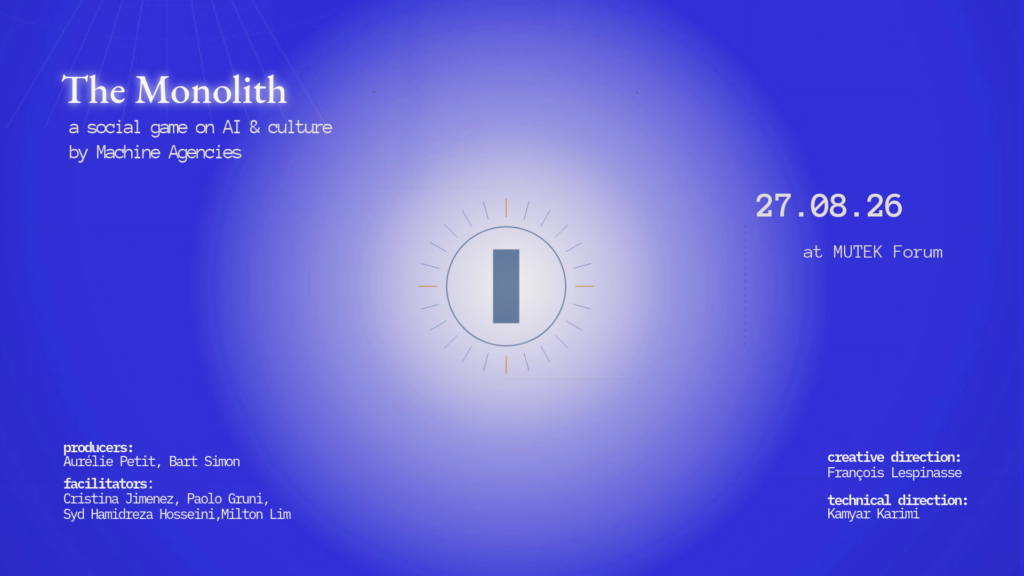
For the third consecutive year, Machine Agencies returns to the MUTEK Forum stage, bringing a critical research-creation lens to Montréal’s signature gathering for digital innovation. Taking place on August 27, 2026 at Édifice Wilder – Espace danse, the research group presents The Monolith, a speculative social game and interactive experience that interrogates our relationship to AI.
Marking the culmination of a four-month residency at Milieux, The Monolith directly echoes this year’s MUTEK Forum theme, Symbiotic Frequencies. “As AI, algorithmic automation, and digital systems reshape how we sense, know, and relate to the world, the most pressing question is no longer what technology can do, but what we want it to become.”— Sarah Mackenzie, Director of MUTEK Forum and Creative Development. True to Machine Agencies’ ethos, Monolith reframes human-machine interaction as a site for social experimentation, creative play, and critical thinking rather than taking a more instrumental and consumerist approach to AI.
A Speculative Social Game on AI & Culture
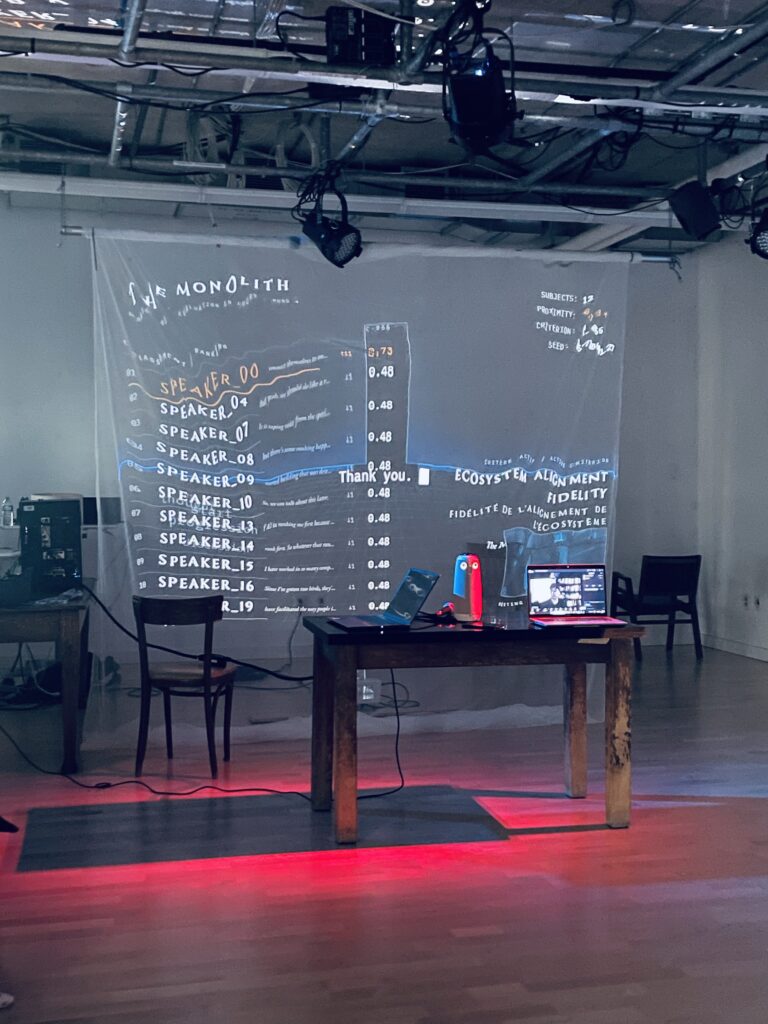
Part interactive experiment, part speculative game, The Monolith invites participants to evaluate Monolith AI’s initiatives that push the limits of creativity and art through technological innovation. Guided by a team of facilitators, visitors are asked to discuss, debate, and share their perspectives on the future of AI in the cultural sector.
Following the experience, attendees are invited to stay for an open Q&A and exchange session with the Machine Agencies team to unpack the game’s outcomes and underlying research.
The Monolith:
📅 Thursday, August 27, 2026
⏱️ 10 AM-12:30 PM: Experience open to the public
12:30-1 PM: Q&A and discussion with the Machine Agencies team.
📍Édifice Wilder – Espace danse (1435 rue de Bleury, Montréal, QC)
The Team Behind The Monolith
Production: Aurélie Petit and Bart Simon
Aurélie Petit is a Postdoctoral Researcher at the Chaire de recherche du Québec sur l’intelligence artificielle et le numérique francophones (IANF) in Montréal, where she works on the (Re)Generative AI for Culture project. She holds a Ph.D. in Film Studies from Concordia University.
Her research explores animation and technology through the lens of gender and sexuality. She has held positions at the Canada Research Chair in Digital Regulation in Work and Life, the AI + Society Initiative at the University of Ottawa, and the Social Media Collective at Microsoft Research, building a body of work that moves fluidly between critical inquiry and creative practice.
Bart Simon is the director of Milieux, TAG research centre co-founder and Professor in the Department of Sociology and Anthropology.
His areas of expertise include game studies, science and technology studies and cultural sociology. His game studies and design research crosses a variety of genres and platforms looking at the relation of game cultures, socio-materiality and everyday life. His current research on the Immersive Theatre and Games, materialities of play, and player-makers in Minecraft is funded by the Social Science and Humanities Council of Canada. Other projects include work on indie game scenes, solar media, social theories of play, and modding cultures.
Creative Direction: François Lespinasse
François Lespinasse is a transdisciplinary researcher and artist from Montréal studying the productive frictions between the humanities and Neuro-AI. After completing an undergraduate and master’s degree in cognitive neuroscience, he is now a doctoral student conducting research-creation in anthropology at Concordia University, where he is affiliated with the Milieux Institute and the Hexagram Network, with support from the Social Sciences and Humanities Research Council of Canada. His research designs spaces in which technology mediates expressive and contemplative practices, shedding light on novel forms of embodied, distributed meaning-making across human and non-human agents.
Technical Direction: Kamyar Karimi
Kamyar Karimi is an Iranian-Canadian digital storyteller and sound artist based in Tiohtià:ke/Montréal. His practice begins from the idea that stories do not belong to a single medium. Within dynamic human networks, narratives circulate, fragment, and re-form through different platforms, and the tools we use to tell stories shape what becomes legible, shareable, or erased.
This perspective runs through his background in programming, game design, and sound design, where he has worked with interactive systems and audio to build narrative experiences that move between technical structure and lived affect. His recent work extends this approach through research-creation design, interaction design, and urban space. Using field recording, sampling, electroacoustic processing, and custom-built digital systems, he investigates listening as a situated practice.
His current projects draw on acoustic justice and evidentiary listening, working with politicized sound environments to ask how voices are framed, filtered, and carried in public space. These works often take the form of immersive listening pieces or installations that position presence and attention as part of the work’s meaning.
Facilitators: Paolo Gruni, Syd Hamidreza Hosseini, Cristina Jimenez, and Milton Lim
Paolo Gruni is a theatre and performance artist based in Tiohtià:ke/Montréal. His work is grounded in collaborative creation, with a focus on theatre as an intercultural space of encounter and transformation. He has worked as a performer, director, playwright, and workshop facilitator across Europe and Canada. Over the past decade, he has developed his artistic practice through intensive research and professional work in diverse cultural and social contexts, including universities, schools, refugee centers, and correctional facilities.
His current research-creation PhD at Concordia University explores experimental theatre techniques and interculturalism in dialogue with studies of perception and consciousness. He investigates theatre as a laboratory of the individual and collective self. He is interested in how performance can shift ways of experiencing the world, and how it may open playful spaces of relation and imagination that challenge dominant structures shaped by capitalism, colonial histories, and heteronormativity.
Syd Hamidreza Hosseini is a Montréal-based theatre practitioner and part-time faculty member in Concordia University’s Theatre Department. Working at the intersection of performance and technology, he is the founder of the CyberShakespeare collective, which has brought performances to audiences in the United States, the United Kingdom, France, Iran, Sweden, and Canada. Across his career, he has worked as an actor, performer, director, and dramaturg, with a practice rooted in community-led creation. Performance-making, in his view, is a capacity that belongs to everyone. He puts that conviction into practice by collaborating with people outside the arts sector and building pathways into performance for broader communities.
Cristina Jimenez is an interdisciplinary artist and educator based in Tiohtià:ke/Montréal, working at the intersection of theatre, performance art, and digital practice. With a foundation in performing arts and a specialization in acting, her work draws on psychogeography, expanded theatre, gamification, interactivity, and digital media to create experiences that challenge the boundaries between stage and street, performer.
Jimenez is a PhD candidate in the Individualized program at Concordia University, and is affiliated with the Hexagram Network, Milieux-LeParc, Centre for Oral History and Digital Storytelling (COHDS), Acts of Listening Lab (ALLab), Faculty of Media Studies (FMS), and SenseLab-3e. She is also a board member of Teesri Duniya Theatre. Her work has toured across Europe and the Americas.
Milton Lim is an award-winning Canadian game designer, media artist, and performance creator based between Vancouver and Montréal. His research-based practice entwines public data, interactive digital media, and gameful performance to create speculative visions and candid articulations of social capital.
He is a co-founder and a creative director of STUDIO FUNFUG, a co-founder and key archivist with videocan, the national video archive of performing arts documentation, and a co-artistic director of Hong Kong Exile. He serves as an artistic associate with Theatre Conspiracy, was a former artistic-leader-in-residence at the National Theatre School of Canada, and is one of the co-creators of both culturecapital: the performing art economy card game and asses.masses: the video game. In 2022, asses.masses received the prestigious National Creation Fund from the National Arts Centre of Canada and is currently touring globally in ten languages.
Milton holds a BFA (Hons.) in theatre performance and psychology from Simon Fraser University in Vancouver. He is currently pursuing a PhD at Concordia University in Montréal, researching the rampant gamification of civic life and the future of storytelling.
The Monolith is a project developed by Machine Agencies and produced by Milieux Institute and the Hexagram Network for MUTEK Forum.
