I’ll admit I’m a little lost. You could say Concordia is maze-like, but I always thought campus was like a utility vest where you constantly discovered new layers and pockets, pockets within pockets even. So, I wander the 10th floor of the EV building for a few minutes looking for the Performing Arts Research Cluster, a little more disoriented than usual. I had hurried over after a spontaneous blood donation in the library building, much to the volunteer’s chagrin. I just always seem to be in a hurry, rushing from one commitment to another, one project to the next, downtown to the Plateau to Hochelaga to Ahuntsic to Atwater. The moment I enter LePARC, the day’s frenetic pace gives way to something slower, more embodied. It’s as if the space itself insists on presence—and not just because I had to take my shoes off and curl up on the couch.
Lília Mestre guides me into the newly renovated Performance Lab, an intimate space, in sharp contrast with its grand view over bustling downtown Montreal. It reminds me of my childhood dance studio, without the mirrors and barre rail, but it’s a more exploratory space for LePARC members to create, rehearse, and present work.
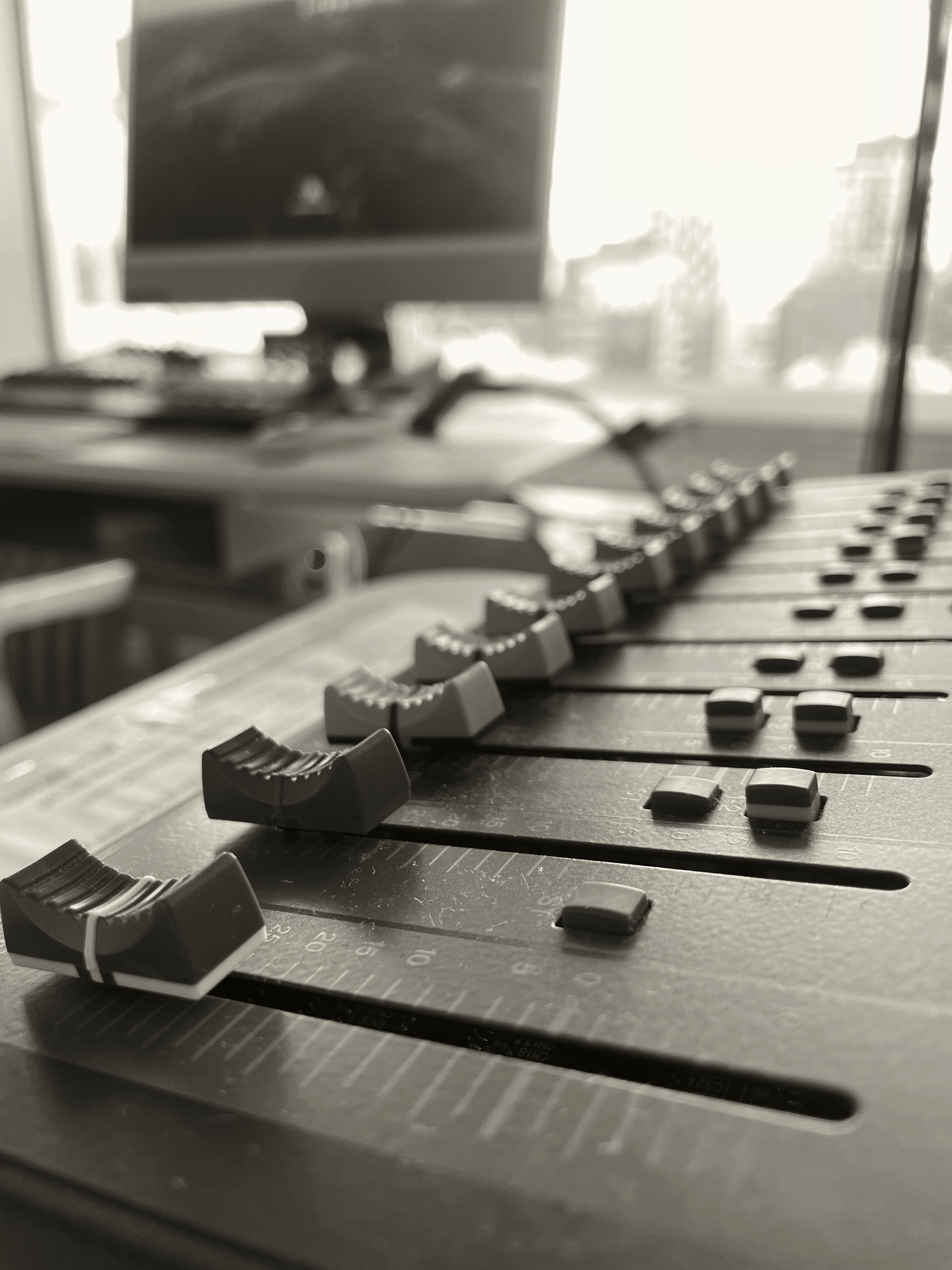
Long a “white box with little access to technology,” as described by cluster coordinator Malte Leander, the Performance Lab is freshly renovated thanks to a grant through the Research Infrastructure Renewal Program. These upgrades opened up new possibilities thanks to the addition of a grid system and Genelec loudspeakers in the ceiling, LED spotlights, an audio mixing console, iMac, and a sprung maple dance floor.
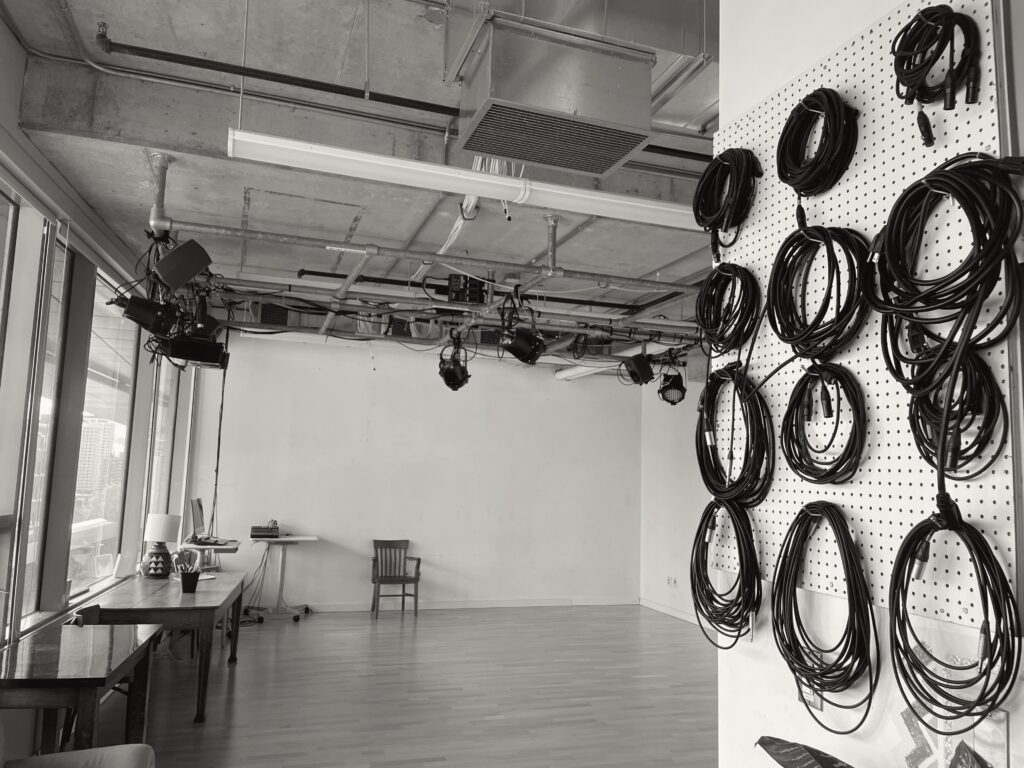
Malte explains that the addition of a sprung floor has “drastically changed the comfort of movement,” making the space more accessible and safe for the many dancers and movement practitioners who make up LePARC.
“There’s another mindset here that proposes to maybe work differently and with another discursive practice attached to it,” Mestre explains, “It’s small but this smallness is very cozy, you know it feels like a womb.”
Mestre, a performing artist, dramaturge, researcher, and Assistant Professor at Concordia’s Department of Contemporary Dance, has been the co-director of the Performing Arts Research Cluster since 2023 along with VK Preston, a cultural historian, and Associate Professor in the Department of History. Preston joins us with haste and apologies, but within minutes the space transforms frantic energy into ease and familiarity.
“I think there’s something bizarrely enough about height, there’s something about leaving the ground floor and there’s this expansive view…” Preston muses, “There are lots of speeds and slownesses that allow this space to be fulfilling and non-isolating.”
“I’ve longed for years to be able to teach in a way that wasn’t predetermined by where the tables and tech are, so that’s been great, we can change it every time.”
Like every Milieux cluster, interdisciplinarity is integral in LePARC, which brings together researchers and artists from disciplines including dance, theatre, music, history, and architecture. The cluster has traditionally been heavily based on dance but has increasingly diversified, with a recent influx of new members with multimedia approaches based in audiovisual expression. Today, LePARC members’ practices encompass, “everything from more analog body centric reflection to a more contemporary multimedia approach to performance practices.”
Mestre emphasizes that LePARC is, “an important cluster for people looking for a modality that maybe doesn’t exist, there’s maybe not a program, but there’s a cluster that can be a research environment for different perspectives about performance.”
LePARC members meet regularly and mostly in-person, to help facilitate these collaborations, which are often unexpected, according to Preston. LePARC’s domain includes the neighboring lab and commons as well as the recent addition of the Immersive Storytelling Studio — now located on the 1st floor (EV 1.631) — where members can design immersive XR environments with 3D technology.
“We do see these really interesting collaborations, sometimes it’s a community member who wants to work with somebody who’s a part-time faculty member and this way there is a place that they can reserve and meet and do really exciting work and take some of that work past the university. So, there are ways in which this allows us to be more in dialogue with artist-run centers.”
Malte explains that, “LePARC is at a very interesting space in time having recently put in motion the policies and introductions of this equipment and the possibilities and potentials are there and I think over the next cycle there’s a possibility for a lot more cross cluster collaborations or for other members of Milieux to come in access the space and collaborate with LePARC members.”
For such a small space, LePARC’s scope of members, affiliates, and projects is incredibly expansive, making the cluster dynamic but introspective, united only by shared interest in performance, in all its forms.
“I think the main question of LePARC is: What are the performing arts? The performing arts are the practice of knowledge production, so how can the arts contribute to society and politics? What is involved in the practice of the arts that can reflect societal and political issues?” Mestre opines.
As the interview shifts to the conversational, I take a step back. It’s been a while since I’ve had the chance to consider the questions Preston and Mestre ask about the body, space, memory, community and publication, questions which used to absorb my work. After thanking the co-directors for their time, I can’t help but linger, my imagination too active to move on with my busy day right away.
– Nadia Trudel, Milieux Storyteller
More about LePARC:
Earlier this year on the Milieux Podcast, co-director Lília Mestre and PhD student Syd Hosseini sat down with Marc Lajeunesse to discuss the cluster’s activities and projects: