Boxes and labels might be useful and neat— but they never led to innovation. Understanding this from its origins, the Milieux Institute’s experimental interdisciplinarity is integral to its identity and appeal, but for the uninitiated, this might make the Institute appear confusing or daunting. For Concordia University’s inaugural Research Institute Day, Milieux sought to demystify and opened its doors to the community.
What is Milieux?
The question on everyone’s lips, and the answers vary so widely you might leave with more questions than you started with. To summarize, Milieux is an independent institute for research-creation based out of Concordia University. With a diverse membership working at the intersections of technology, fine arts, and digital culture, Milieux produces innovative and accessible research and creative projects, breaking down traditional barriers between researchers and artists, and between universities and their communities. In pursuit of this, the institute defies many of academia’s traditionally hyper-competitive and individualist attitudes in favour of collaboration and peer-support.
During Institute Day’s opening panel, Milieux director Bart Simon explained that “Each premise of the entire operation of the Institute is that social and cultural life is imminently technological. Can’t separate the two. So a lot of what concerns us, whether we’re obsessed with video games, or obsessed with virtual reality, or interactive textiles or bio art or any of the other things that go on at Milieux, it’s really this complex assemblage of technical, social, and cultural elements that make up contemporary life, without collapsing them into their usual disciplines. We recompose all of that as a giant, messy problem that requires all these disciplines at the same time.”
What are Clusters?
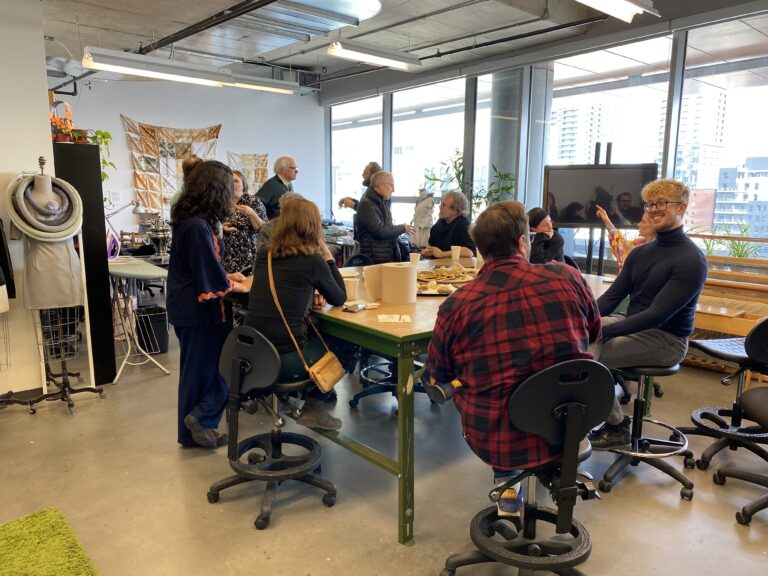
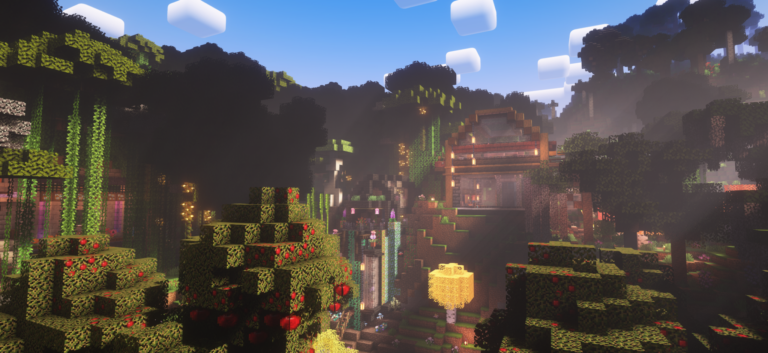
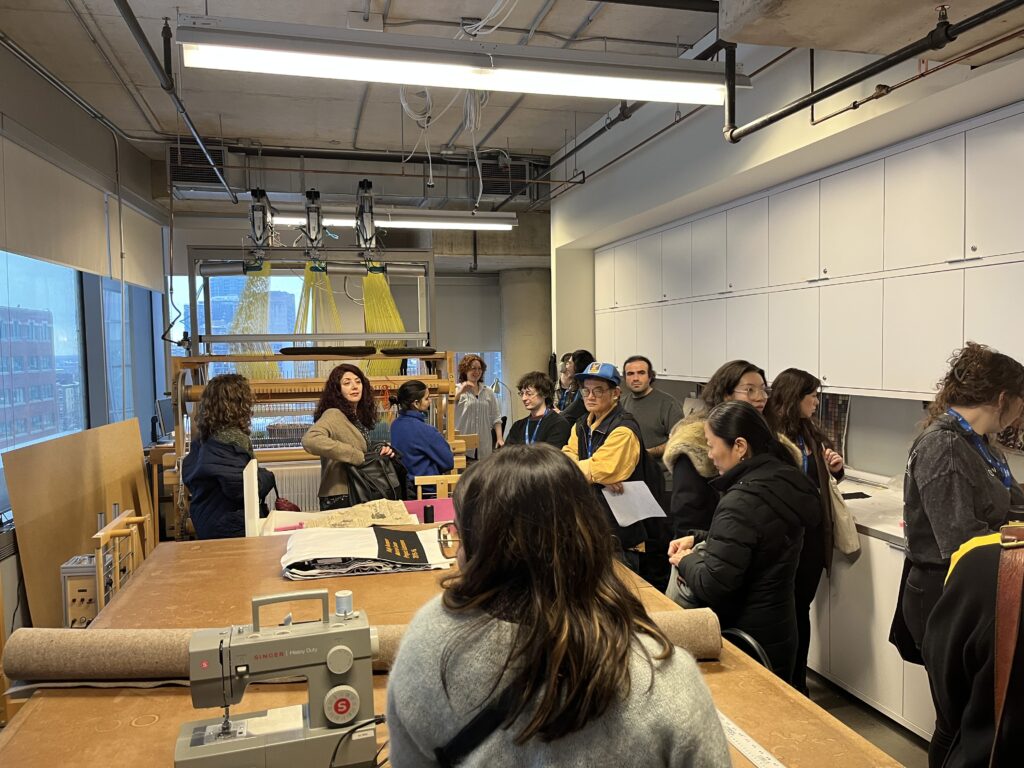
After the opening panel, the public was invited to tour the 11th and 10th floors of the EV building which houses the Milieux Institute and its clusters, letting the facilities and projects speak for themselves: solar panels that power a Minecraft game, the biggest collection of video games in Canada, vitrine of mycelium sculptures and 3D-printed ceramic vases, screens playing student films, shelves of books written by members of the institute. Milieux is vibrant and unexpected—every time I manage to visit, I discover new projects and members that leave me wondering how I’d never heard of them before.
The Milieux Institute currently comprises seven independent research clusters with unique but often overlapping cultures, interests, and members. As research interests evolve, so will the institute, leaving enormous potential for new research clusters to emerge.
- Technoculture, Art & Games (TAG)
TAG is a cluster dedicated to digital game research and design, widely recognized as the largest and most-established games research centre in Canada.
- Indigenous Futures Research Centre (IFRC)
IFRC supports research led by and/or for Indigenous peoples and communities, incorporating Indigenous methods for knowledge recovery, discovery, and transmission.
- Textiles & Materiality
Drawing on Concordia University’s expertise in textiles, Textiles and Materiality experiments with methods, processes and interdisciplinary modes of thinking, looking at the future of textiles and material objects. The cluster’s facilities notably include a custom Jacquard loom, a Tajima industrial embroidery machine, and several other machines and software for embroidery, looming, design, and sewing.
- Speculative Life
A cluster interested in the complexities and impacts of living in a highly networked world and new technologies. The cluster includes research groups dedicated to A.I., the Anthropocene, material production, finance and infrastructure, as well as a hybrid, interdisciplinary research-creation laboratory, and is also home to the Concordia Ethnography Lab.
- LePARC (Performing Art Research Cluster)
LePARC is a performance practices-based research cluster that develops interdisciplinary research and performances in areas like music, oral history, participatory performance, dance, dramaturgy, and circus. LePARC is also home to the Immersive Storytelling Studio (EV 1.631), a space dedicated to crafting XR environments with 3D technologies.
- Media and Materiality
Media and Materiality examines developments in media and communication through subfields like media archaeology, variantology, new materialism, circulation theory, and technology writing. The cluster is composed of the Media History Research Centre and the DIGS lab which investigate how digital media and digital culture are shaping intimate relationships, gender, and sexuality.
The cluster’s image-based research culture locates itself in-between institutional and community driven art making, grounded in studio practice.
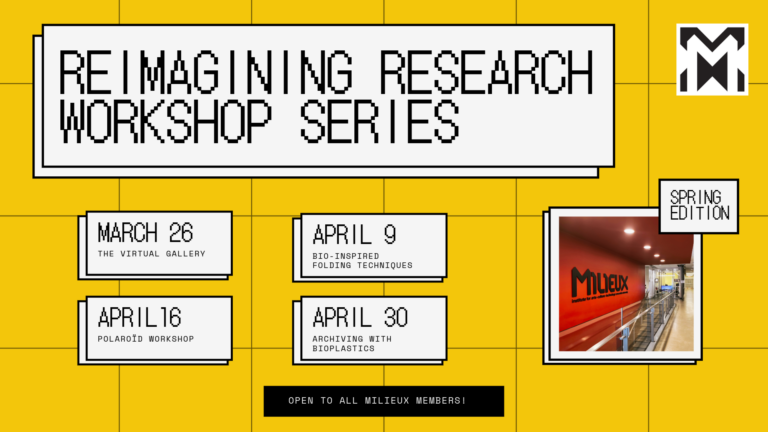
Out of these clusters emerge research projects, exhibitions, performances, workshops, and events, with Milieux providing the supporting framework that allows for interdisciplinary collaboration, through initiatives like the Experiential Workshop Series which introduces students to new techniques and tools. The clusters are communities where reading groups, movie nights, knitting circles, game nights, and social events are regularly organized.
Regardless of cluster association, members of Milieux benefit from the entire institute’s facilities, resources, and activities, allowing them to experiment, explore other fields, and grow.
What does it mean to be part of Milieux?
Milieux was established with the goal of community building, as Director Bart Simon explained at Institute Day, “You come to a program, your job is to take your classes, do your dissertation research, and you get out. But academic life is about much, much more than that. Students join because they have a feeling that there’s something they’re missing.
“It’s about creating the spaces for the students to sort of capitalize on being with one another in this sort of mutual feeling that we can do other things besides just sit at home and try to write our dissertations.”
Expectations for participation vary across clusters, but student participation is critical to the success of the institute because the clusters are largely directed by the interests and initiatives of students. Echoing MIT’s old tradition, Milieux cultivates a strong learning-by-doing culture. Students are actively involved in shaping their own learning environment, building some of the furniture and equipment that make Milieux a unique space within the university. Passing by the Machine Agencies office on the 10th floor, Bart Simon told visitors about how students came together to assemble parts of the research group’s new PC, MAGEN. What began as a creative workaround to university red tape became a valuable hands-on learning opportunity. Over at Spec Life, members told the story of the EthnoLab table, which formed the foundation of the cluster and their culture.
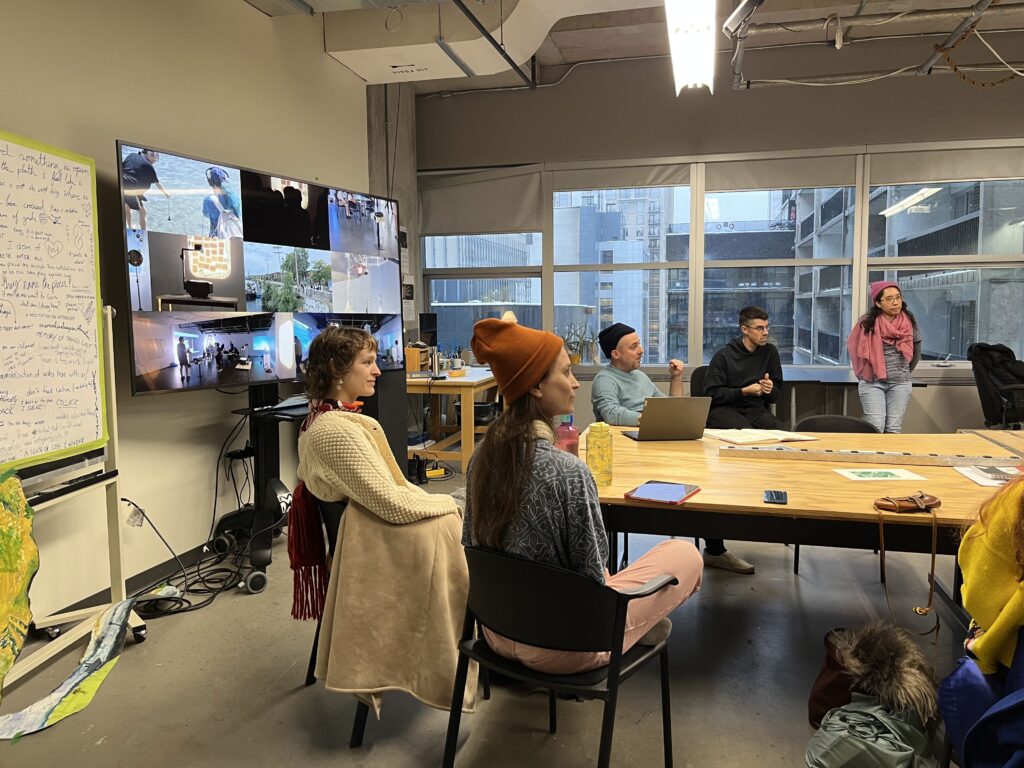
Examples like these are not exceptions and can be found throughout the institute. Students are encouraged to explore beyond their cluster, and the institute is there to support this curiosity by providing the conditions for it to flourish. Open to all members, the Milieux Commons labs -the BioLab, the Maker Space and the most recent addition, the MaSH lab– are spaces created to foster creativity and push research forward. Once they receive the proper training and get safety accreditation, students are trusted to operate the equipment on their own. While technicians are available to assist with more complex projects, students are ultimately empowered to take initiatives, assist one another, and participate in maintaining these vibrant research spaces.
Members of Milieux benefit from the institute’s international network of researchers and professionals, equipment and resources, places to socialize and work, feedback from peers and faculty, participating in research groups and projects, access to professional and social events, promotional, professional, and academic opportunities, and more.
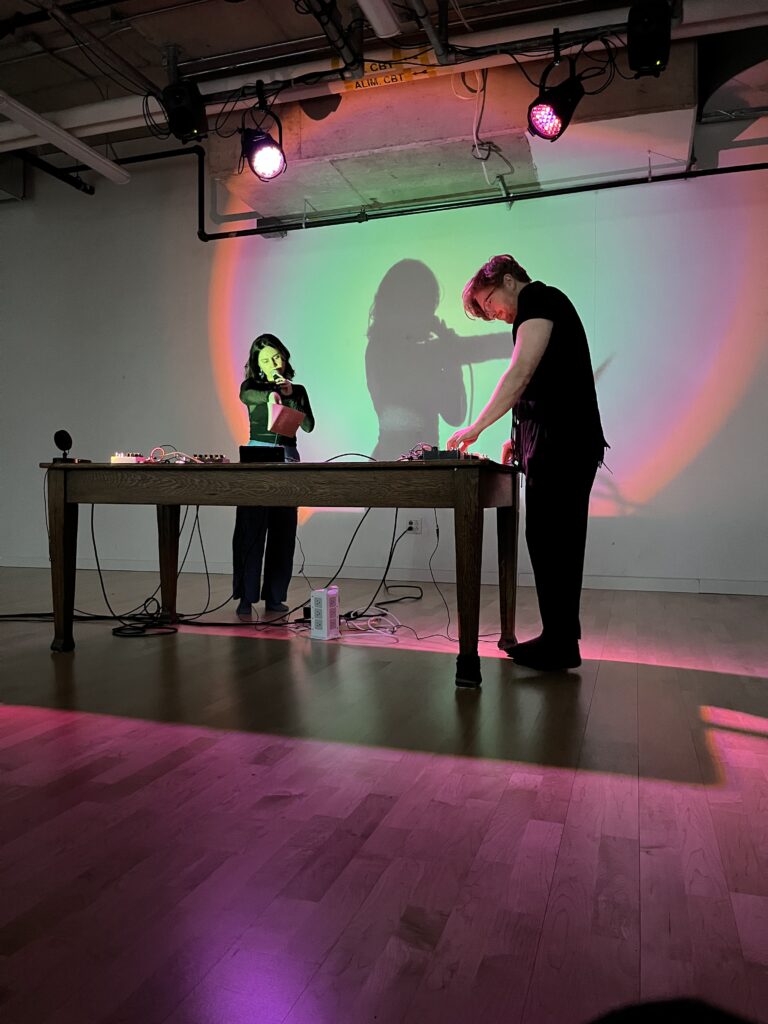
Understanding the changing professional landscape and dwindling job opportunities in universities, Milieux works to highlight the groundbreaking work of its members and provide opportunities with artist-run studios, festivals, exhibitions, and publishers.
“A lot of what drives us is the students telling us that this is the best experience of their entire graduate careers. If you’re choosing a graduate career, especially in this age, you’re investing money, and time, then you better learn to enjoy it,” Simon opined.
The institute’s aesthetic is pleasing and its accomplishments are lengthy, but from the start, I was struck by the way members wax about Milieux. I quickly understood its significance went far beyond the academic, artistic, or professional for many. In the three months since I started haunting the halls of the EV building trying to get interviews, members have shared with me that Milieux is the reason they came to Concordia or came to Canada, that thanks to Milieux they’ve expanded their practice and research in unexpected and exciting directions, they’ve found important partners in research and creation, some even consider Milieux family.
As students, artists, researchers, and educators contend with increasingly uncertain futures, Milieux acts as a crucial refuge, reminiscent of better days while consistently pushing ahead, anticipating and preparing for the future.
How Can I Join?
Graduate and postgraduate students typically discover the institute through a committee member affiliated with Milieux or by knowing someone already involved. But Milieux and its clusters regularly host events, workshops, seminars, book talks, guest talks, and more that are open to the public. What matters is the engagement of the community. So, if you’re interested in being part of this vibrant research community, stay in the loop, subscribe to the newsletter, listen to the Milieux Podcast, start showing up to events, and see what happens; you’re sure to be surprised.
– Nadia Trudel, Milieux Storyteller