Another year, another class of hungry UG fellows. Since 2017, the Milieux Institute has encouraged undergraduate ambition through its UG Fellowship initiative, which provides financial support, access to resources, networking opportunities, and Milieux membership to undergrads nominated by Milieux’s clusters.
Research-creation at university is typically dominated by graduate and post-graduate students who have dedicated themselves to an academic path, even if it doesn’t always improve job prospects. In contrast, the undergraduate level is broad, saturated, and frequently catered to the job market. My time as an undergrad at Concordia University was marked by productivity: internships, the start of my freelance career, bullet points for my CV— all for a type of career that barely exists anymore. If undergrads are chasing opportunities, then graduate and post-graduate students are buckling down to do their work, even if the academic milieu is in many ways less hospitable than it once was.
Amid funding cuts, strikes, and uncertainty, it’s astounding to see undergraduates going far beyond the demands of their degrees, and so I caught up with the outgoing 2024-2025 cohort of UG Fellows to understand: why?
What quickly emerged when interviewing the outgoing UG fellows was the active role played by clusters in fostering a research environment where undergrads feel included and are encouraged to take initiatives.
Towards the end of his time studying marketing and real estate at the John Molson School of Business, Quinn Saggio took an English elective about video games as literature with Dr. Darren Wershler, who complimented Quinn’s work and pointed him to TAG.
“It really felt like I was being picked. It was nice to hear that this is meant for you. Try it out.”
Quinn joined the Minecraft Bloc research group under Milieux Director Bart Simon, contributing to the SunBlock One project, a solar-powered Minecraft server designed to push players towards a social dynamic around shared, finite resources.
“For me growing up with video games playing all the time, I was instantly hooked. So, I threw away all my marketing stuff. I decided, okay, you know what? I’m going to dedicate an extra year just seeing what can happen,” he explained.
Initially daunted to enter the world of graduate researchers, Quinn found that his “fresh and untouched eyes” brought a unique perspective to projects and ended the fellowship feeling bittersweet about having only found the cluster at the end of his degree.
“I would say they gave me all this opportunity to actually learn what I had been passionate about. This was that opportunity to explore what was out there, more than just the commerce side and what could be marketable to businesses later on.”
Destiny Chescappio jokes about being “chased down” by members of the Indigenous Futures Research Centre (IFRC) who recognized her potential and wanted to bring her into the cluster.
Destiny worked in the AbTeC studio lab creating pieces like the interactive Aurora Borealis, which brings myth to life, depicting reservation life in cyberspace through RezPunk, and the human robot RezBorg characters. Through the fellowship Destiny gave several talks about her practice and got the opportunity to teach workshops at places like MUTEK.
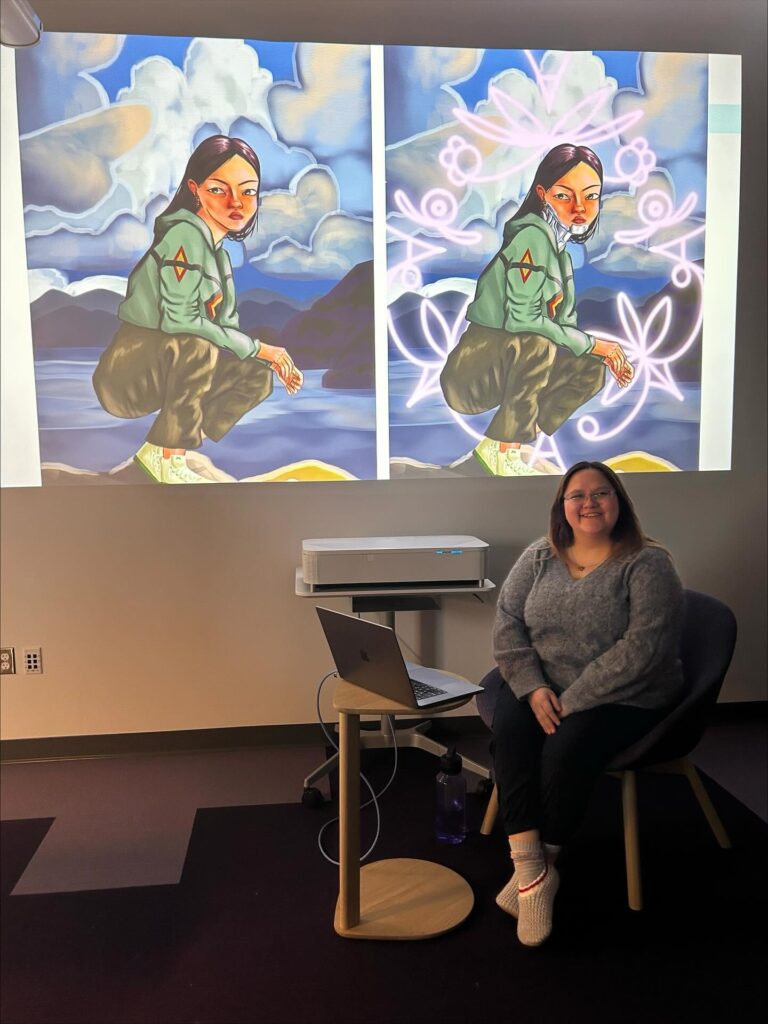
“Not only was it a great learning experience, but also it was a great pathway for me as an individual and artist, to be able to network.”
Now established as a freelance artist, Destiny’s work continues to gain recognition. RezPunk has been selected for the next edition of the imagineNATIVE Festival in Toronto and she will participate in a virtual production workshop in Winnipeg.
“Altogether, I can say that they really gave me the chance to open myself up as a practicing artist,” she said of the fellowship.
Contemporary dance student Rena Adell Eyamie was recruited by LePARC co-director Lília Mestre. With her graduate studies now underway, and Mestre as a supervisor, Rena describes herself as a builder of bodies—be they made of “fabric, flesh or word”, Rena describes her research-creation practice as “porous,” moving fluidly between the tactile world of fibres arts and the gestures of performance.
Over the course of her fellowship, she participated in LePARC’s annual Embodied Interventions showcase, where participants develop and present a performance-based project over two weeks. As part of Embodied Interventions, Rena worked with her own hair as a material to inspire dance, work that has carried over into her master’s.
“I’m still the youngest person in the room for those things, but I still feel really invited in and like my work is of the same level. It’s of the same value. Just having the support and the weight behind my research, seeing that it was interesting to these organizations and that it was worthy and rigorous enough to be recognized was really lovely and positive.”
As charming as Chosen One narratives are (and they really are), the interviews also revealed a more pragmatic aspect of the fellowship.
Aidan Catriel, a computer science major with a mission “to watch giant spaceships blow each other up in VR” spent his time at TAG working with teammates in the TAG Lab and drawing on the expertise and passion of nearby cluster members, “I can call someone over. Hey, can you just play this for 20 minutes? Tell me what you think.”
Despite his age, Aidan is impatient to reach his goals as the founder of WhySo Studios, an independent video game studio. While operating at the equivalent level of graduate and post-graduate students, he bemoans, “Nothing happens as fast as I would like.”
For anthropology student and IFRC’s communications coordinator, Milo Puge, the undergraduate fellowship was a natural transition. Milo shared the difficulty finding undergraduate students for the fellowship because most aren’t ready to make the leap into the research-creation work done at the institute. However, his involvement in the cluster and substantial experience made him an excellent candidate.
“We’ve had a couple more undergraduates this year, which is really nice, being able to show them what you can do, showing the path forward of what graduate research can look like and how you can start researching as an undergrad.”
With a background in comic and children’s book illustrations and language revitalization, Milo works to incorporate his arts practice into his research. During his fellowship, Milo made the most of the institute’s cross-disciplinary environment. Having an interest in fibers, he naturally connected with the Textiles and Materiality cluster, allowing him to use specialized equipment to expand his craft.
Milo was one of many UG fellows who described the fellowship’s capacity to demystify research and illuminate paths forward. Starting the UG fellowship as an Honours Anthropology undergrad, Sophie Alexandra Manker is still at Concordia, still part of Spec Life, now a master’s student in environment.
Sophie heard about the Milieux Institute among the tight ranks of the Anthropology department, where she nursed a desire to bridge the gap between ethnographic methods and technical skills she was developing. Alongside friend and fellow 2024-2025 UG fellow Annabel Durr, Sophie joined the Speculative Life cluster, “We both have very similar interests that really fell in line with the institute and kind of like the opportunity to do interdisciplinary work like that was really intriguing.”
A born-and-raised Montrealer, Sophie explores urban issues related to water, leading her to join the Montreal Waterways collective, a research group born out of the Concordia Ethnography Lab. There, she works to reconcile the personal stories of those living through environmental changes with the data of flood risk maps.
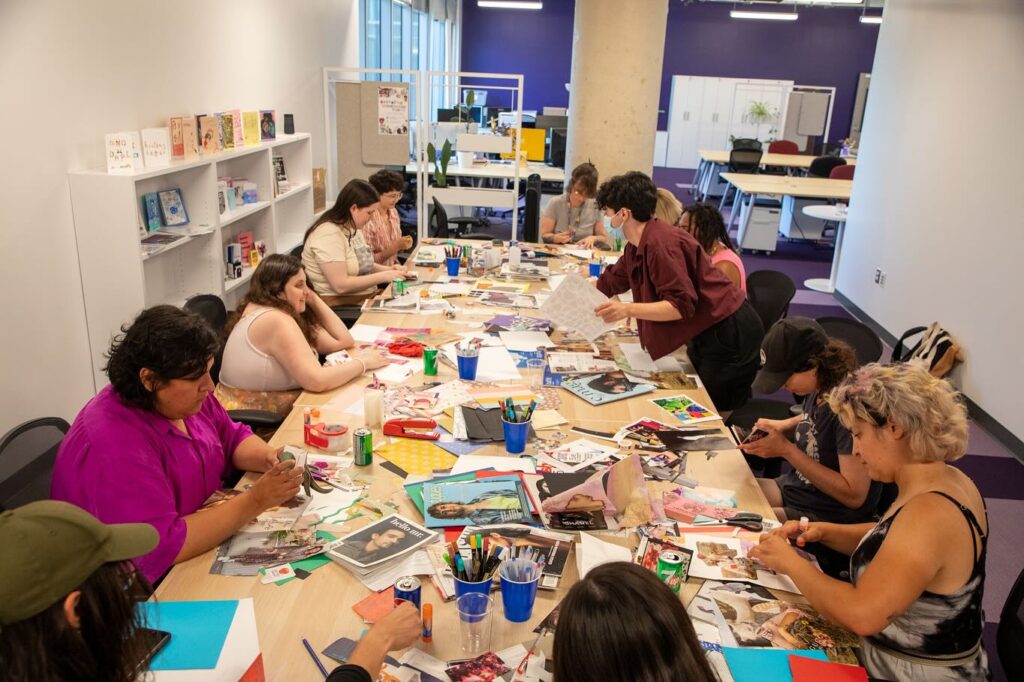
The lab’s signature table and “conversation generator” would serve an important role in Sophie’s integration process.
“That’s a centerpiece of collaboration and so the whole point of sitting around the table is to collaborate together in thought. Just like bouncing ideas off of each other is really fun and there’s no pressure. [The UG Fellowship] taught me a lot about the value of collaborating with other disciplines. I think participating in the kind of research that was happening was really cool because you really got to see how different people’s skill sets could become part of one main research project and it made me realize how much I love being part of a team like that. I hope in the future to be part of a team like that, I really want to keep that going in my life.”
– Nadia Trudel, Milieux Storyteller
Learn more about this year’s cohort :