
Graduate Summer Institute at Concordia University, August 10-21, 2026
Instructor: Kregg Hetherington, Concordia University Chair in Environmental Ethnography with support from Patrizio McLelland and Polina Shubina.
Deadline to apply: April 1st, 2026
Ethnography has traditionally presented itself as a practice of “participant observation.” In this course we shift the sensory focus to “participant listening,” and ask how an aural engagement with the world differs from our more familiar visual engagements. Over two weeks of intensive theory and practice, students will experiment with new ways of sensing the socio-natural environment and build collaborative projects that foreground how sound shapes our experience of the world.
- The course is partly classroom-based, and we will spend much of the first week reading, learning from experts and practicing various techniques of listening at the Concordia Ethnography Lab.
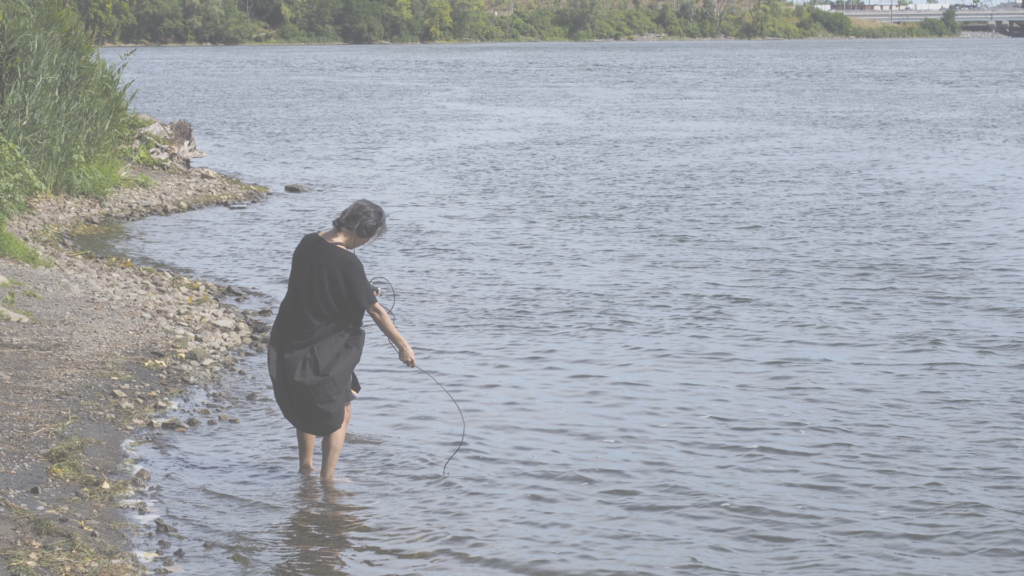
- The other part is field based. Taking the Verdun shoreline as our ethnographic object, students will work together to convey the environmental complexities of a place where land meets water, city meets river, and many species contend with histories of colonialism, industry and wonder.
The course is run in parallel with a similar course run by Heather Swanson and Knut Gunnar Nustad at the University of Oslo, and we will meet their group several times throughout the course as they work in parallel on Oslo’s Akerselva river.
The course includes an introductory grounding in anthropological theory and method, but is open to students with interdisciplinary backgrounds.
EXPERIMENTS IN ENVIRONMENTAL ETHNOGRAPHY
Participants listening at the shoreline
Photo credit: Simon Parent
Course Schedule
A detailed syllabus will be available before formal registration (see below). The schedule of meetings may vary somewhat from day to day, but you should be prepared for an intensive two-week experience.
Course Requirements
Students do not have to have any specific ethnographic, artistic or recording experience to take the course, but any of these skills will be an asset. The course itself is intensive: students need to be present for all aspects of the course, read all required readings, and be prepared to work intensively on a collaborative group project. Graded components of the course include short online presentations, a personal reflection essay, a collaborative multimodal work-in-progress, and a final paper.
Registration and Course Credit
Spaces are limited, and applicants need to receive permission from the course instructor. To apply to participate, please click the REGISTER button in the banner.
The deadline for filling out the form is April 1st . We will then invite you to register formally for the course. There was too much interest in last year’s course for us to accept all applicants, and we were unable to accept any auditors.
Students will receive graduate credit in Anthropology from Concordia University. In exceptional circumstances, students may ask for alternate credit.
Auditing the course
Once we know how many people are formally registered for the course, we may open some spaces for auditors for some portions of the class. If you would like to be considered for one of these spaces, indicate it on the registration form.
Cost
The cost of registration is regular tuition for a 3-credit course at Concordia. Please consult Concordia’s webpage for current tuition rates and be aware that students form outside of Quebec will pay higher tuition. Any additional costs for travel to Montreal, and for getting around the city, are the responsibility of participants.
Supported by
Department of Sociology and Anthropology